Research compound stacks
Curated guides to the most commonly combined research peptides — what they are, why they work together, and how to source them across five markets.
All stacks
Research compound combinations
The Wolverine Stack
BPC-157 + TB-500 — the most studied recovery combination in research peptide literature
- Accelerated tendon and ligament repair
- Gut lining protection and healing
- Reduced systemic inflammation
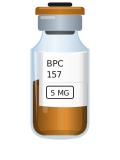 BPC-157
 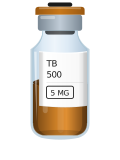 TB-500
 The GH Stack
CJC-1295 + Ipamorelin — synergistic growth hormone release without cortisol elevation
- Synergistic growth hormone release
- Clean GH stimulation — no cortisol spike
- Sustained baseline + acute pulsatile GH profile
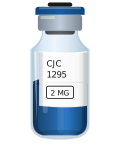 CJC-1295
 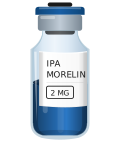 Ipamorelin
 The Metabolic Stack
Retatrutide + AOD 9604 — next-generation GLP-1 combined with the Australian-developed fat metabolism compound
- Triple GLP-1/GIP/glucagon receptor activation
- Direct fat cell lipolysis via beta-3 adrenergic receptors
- Complementary weight loss mechanisms
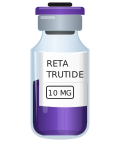 Retatrutide
 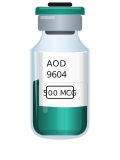 AOD 9604
 The Longevity Stack
Epithalon + GHK-Cu — telomere support and collagen synthesis for cellular longevity research
- Telomerase activation and telomere support
- Collagen and elastin synthesis stimulation
- Cellular and structural anti-aging mechanisms
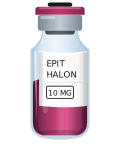 Epithalon
 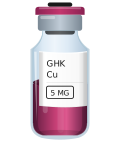 GHK-Cu
 About stacks
Why combine compounds?
Research compound stacks are combinations of peptides that are commonly studied together because they work through complementary mechanisms. Rather than targeting the same pathway twice, well-designed stacks cover different parts of the same biological process.
The most studied example is BPC-157 and TB-500 — one specialises in tendon attachment and gut tissue, the other in systemic muscle repair and angiogenesis. Combined, they cover more of the healing cascade than either alone.
All stacks on Peptide Library are based on combinations documented in research literature. We explain the mechanism behind each combination in plain English, along with market availability and vendor information.