The Longevity Stack
Epithalon and GHK-Cu are two of the most studied peptides in longevity and anti-aging research. Epithalon is studied for telomerase activation and circadian regulation. GHK-Cu targets collagen synthesis, wound healing and skin repair. Together they address cellular aging at multiple levels.
- Telomerase activation and telomere support
- Collagen and elastin synthesis stimulation
- Cellular and structural anti-aging mechanisms
- Oxidative stress reduction
- Naturally occurring compounds that decline with age
What is The Longevity Stack?
Epithalon + GHK-Cu — why combine them?
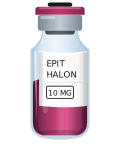
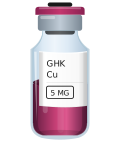
The Longevity Stack combines two peptides with distinct but complementary anti-aging mechanisms. Epithalon (Ala-Glu-Asp-Gly) is a synthetic tetrapeptide derived from the pineal gland peptide epithalamin, studied extensively by Russian biogerontologist Vladimir Khavinson for telomerase activation. GHK-Cu is a naturally occurring tripeptide-copper complex found in human plasma that declines with age.
Both compounds are backed by substantial research — Epithalon primarily from Russian institutions, GHK-Cu from a broader international research base including decades of cosmeceutical application.
Epithalon targets cellular aging at the DNA level — activating telomerase to maintain telomere length in somatic cells. GHK-Cu targets tissue aging at the structural level — stimulating collagen, elastin and glycosaminoglycan synthesis while reducing oxidative stress. They address aging from the inside out and outside in simultaneously.
Plain English
What this means for you
If you are researching compounds for longevity, cellular health and skin aging, this stack combines two of the most studied peptides in this space.
Think of Epithalon as working at the cellular level — potentially slowing the aging clock in individual cells by maintaining the length of telomeres, which shorten with each cell division. GHK-Cu works at the tissue level — rebuilding the structural proteins that give skin and connective tissue their integrity.
One addresses how long your cells can keep dividing. The other addresses the quality of the tissue those cells make up.
The compounds
What's in this stack
Why they work together
Complementary mechanisms
Source this stack
Where are you based?
Select your market to see COA-verified vendors for both compounds. We only list vendors with third-party purity certification.
Available from verified vendors. Click to view options for your selected market.
View Epithalon vendors →Available from verified vendors. Click to view options for your selected market.
View GHK-Cu vendors →